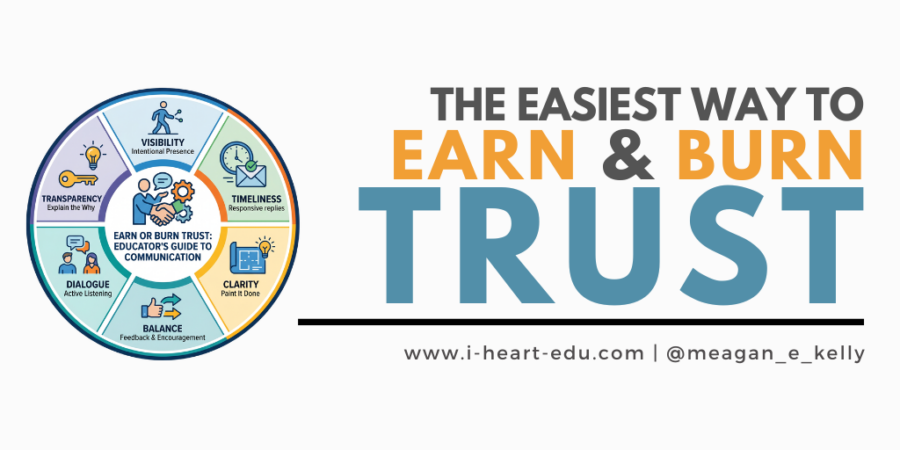
Building trust on a school site is one of the most important things we can do to make real movement happen. Without trust, it is impossible to cultivate a positive school or classroom culture. Without a positive culture, we can never truly empower our people or ignite their passion. And without passion – from both educators and students – learning will never move as far or as fast as we want it to.
Education is incredibly hard work. To get the best out of it, everything starts with trust.
There are a multitude of ways to build trust on a school campus. Yet, there is one guaranteed way to either earn or burn trust with the people you serve.
Communication.
Whether you are a principal leading a staff of adults or a teacher leading a classroom of students, effective communication earns you an immense amount of capital. Conversely, failing to communicate consistently will quickly (or slowly) watch that trust burn away.
Before I break this down, I want to be entirely transparent: I am far from perfect at this. These are things I have to intentionally work on every single day, and some days are definitely better than others. My hope is always that my staff sees that ongoing effort. Education is incredibly hard work, and to get the best out of it, everything—and I mean everything—starts with trust. Because at the end of the day, if we don’t have trust, we will never truly be able to move our people forward, whether it’s our staff, our parents, or our students.
Let’s break down the six communication pillars that dictate how we earn or burn trust on our campus every day.
1. Communication is Consistent and Visible
Trust cannot be built from behind a desk – whether that desk is in the front office or at the front of a classroom. We have to be present and among our people.
-
How to Earn It: Be intentionally visible by getting out as often as possible. For leaders, make it a point to be present during those critical transition times – standing outside before and after school, walking the campus during lunch, and actively getting into classrooms every single week. For teachers, the focus is on maximizing your proximity by greeting students by name at the door or taking intentional time during class to get to know them individually.
- Pro-Tip: Track your micro-connections intentionally to ensure no one slips under the radar. Leaders can keep a weekly staff roster on a spreadsheet for quick two-minute check-ins, while teachers can use a laminated seating chart or checklist to ensure they have a quick, non-academic conversation with every student by a specific day of the week.
-
How to Burn It: Becoming a ghost in your own building or classroom. When you isolate yourself, you miss the chance to truly know your people.
2. Communication is Timely
There is a quiet danger when staff or student questions go unanswered. Unanswered emails and ignored messages send a loud signal that their needs are not a priority. When people are left hanging, they might try reaching out a second time, or they simply start to worry that they’ve done something wrong. But over time, that confusion turns into a sense of defeat, leading to total disengagement where they completely stop trying to connect with you. They decide it’s easier to struggle in silence than to face another ignored message, and once someone stops reaching out, rebuilding that bridge is incredibly difficult.
-
How to Earn It: Respond within a reasonable window. You don’t have to answer within minutes. Complex issues might require some thought or research. If a delay is inevitable, send a quick placeholder: “I want to make sure I give you the right answer. Give me a bit to look into this and get back to you.” However, remember that a placeholder is only half the commitment – true trust is earned in the follow-through. Make it a strict personal priority to actively circle back and deliver that answer as timely as possible once you have the information. True timeliness means you don’t let days pass or force them to follow up again; you proactively close the loop the moment you have the clarity they need.
-
Pro-Tip: Once you send that placeholder, immediately mark the message as unread or use the “snooze” feature. Marking it unread keeps the message bolded at the very top of your inbox as a visual anchor every time you look at your screen. Alternatively, snoozing the email allows you to temporarily clear the clutter and schedules the message to pop back into your feed at a specific, reasonable time when you actually have the margin to give a thoughtful response.
-
-
How to Burn It: Workplace or classroom “ghosting.” Forcing your staff, parents, or students to follow up multiple times just to get a basic answer kills momentum and mutual respect.
3. Communication is Clear
Borrowing a core truth from Brené Brown’s Dare to Lead: clear is kind. Your people should never have to guess what success looks like. But being clear isn’t just about handing out clear assignments; it is also about having the courage to hold clear conversations when something isn’t going well. While it can be tempting to beat around the bush or soften a tough message to avoid discomfort, being vague is actually unkind. True kindness means providing the absolute clarity people need to learn, adjust, and grow.
-
How to Earn It: Paint a crystal-clear picture of expectations. Use Brené Brown’s concept of “Paint It Done.” Instead of just communicating the mechanics of a task or assignment, describe exactly what a successful end product looks like. Leaders do this when delegating a new campus initiatives, projects or events; teachers do this when introducing a rubric or project. Slowing down to share the complete context, timeline, and purpose eliminates hidden assumptions.
-
How to Burn It: Shifting targets and ambiguous directions. Responding too quickly without thinking through potential roadblocks ahead of time breeds massive frustration.
4. Communication Balances Feedback with Encouragement
Feedback is the engine of growth, but it must be paired with genuine encouragement to keep people motivated, positive, and willing to try again.
-
How to Earn It: Balance critique with celebrating wins. The “sandwich” method (Positive – Feedback – Positive) works beautifully for routine evaluations or student grading where steady growth needs to be acknowledged. However, it is important to recognize that there is also a time and place where conversations simply need to be entirely direct.
-
Disclaimer: If there is a serious issue or an ongoing problem, circling back to #3 and remembering that “clear is kind” is your best approach. People absolutely need to know exactly where their areas of improvement lie, and in those specific accountability situations, you might not be able to balance the encouragement piece as much. Being upfront and honest in those tough moments is its own form of respect.
-
-
How to Burn It: Only showing up when something is wrong. Offering nothing but criticism while ignoring steady growth ensures that your students will tune you out, while your staff will become discouraged.
5. Communication is a Dialogue, Not a Monologue
True communication is a two-way street that requires active listening followed by collaborative problem-solving.
-
How to Earn It: Slow down and fully focus on the person speaking to you instead of just planning your next response. Ask more questions than you provide answers. Leaders use coaching questions to help teachers find their footing; teachers use inquiry to guide students to their own “lightbulb” moments. Guide your people toward their own solutions by listening deeply.
-
How to Burn It: Being visibly distracted by a screen during a conversation, or dominating the room so completely that others feel shut out of the conversation.
6. Communication is Transparent
When people understand the reasoning behind a decision, a timeline, a grading policy, or a shift in strategy, buy-in skyrockets.
-
How to Earn It: Be radically open about the “why.” For leaders: Explain the data or district shifts driving a new campus policy. For teachers: Explain the purpose behind a specific assignment or classroom rule. Even when you cannot share every detail due to confidentiality boundaries, being open about why decisions are made builds deep respect.
- Pro-Tip: Check out Simon Sinek’s book, Start with Why, for an excellent dive into developing and sharing your why with others.
-
How to Burn It: Operating behind a curtain. Keeping the “why” a secret leaves a vacuum that people will inevitably fill with gossip, anxiety, or resistance.
The Takeaway: Every interaction on a school campus is an exchange of trust. Whether you are leading the school or leading the classroom, keeping your communication visible, timely, clear, balanced, collaborative, and transparent builds a foundation strong enough to handle any challenge the school year brings.
Which of these pillars comes most naturally to you, and which one is your biggest “work in progress”? More importantly, what am I missing here? What other communication habits do you rely on to keep your campus or classroom running smoothly? Let me know in the comments below!